Scissor Lift vs Boom Lift: Which One Do You Need?
· Three Points
Scissor lifts and boom lifts both put people and tools safely at height, but they solve different problems. Choosing the wrong one usually shows up on day one: a scissor lift that cannot get past a row of racking, or a boom lift with a basket too small for the materials the crew needs. This guide explains the difference in plain terms and gives you a checklist to decide.
The short answer
- Choose a scissor lift when the work is directly above a floor you can drive or push the machine onto, and you need room for several people, tools and materials.
- Choose a boom lift when something is in the way — machinery, a canopy, a roof edge, a ditch, a tree — and you have to reach up and over or out to the side.
- If you need both height and outreach, or the ground under the work point is not accessible, a boom lift is the only practical option.
How a scissor lift works
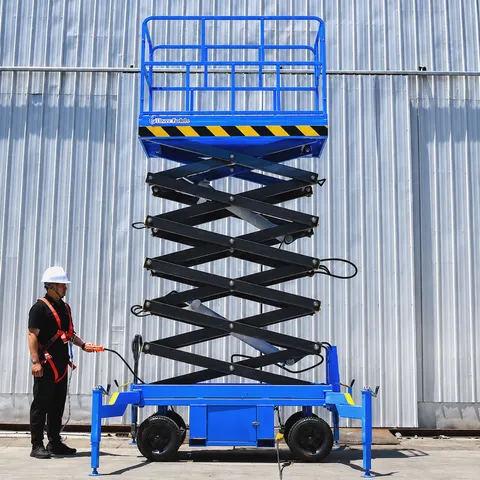
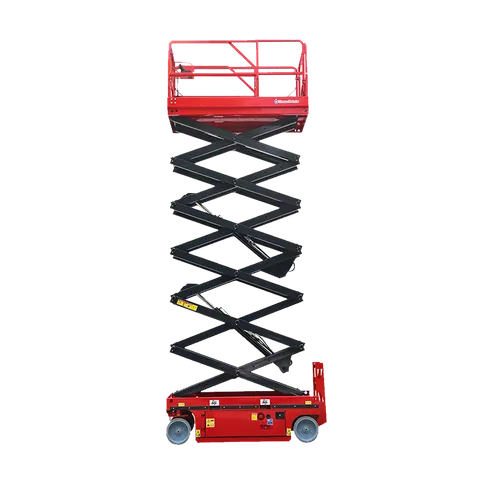
A scissor lift raises its platform straight up on crossed steel arms driven by a hydraulic cylinder. Because the load sits directly over the chassis, the platform can be large and the rated load high. Our mobile scissor lifts, for example, range from 300 kg to 3000 kg capacity and from 6 to 26 m working height, with decks up to about 4 m long.
The trade-off is that a scissor lift only goes up. Its platform must be positioned directly below the work, so anything on the floor underneath — machines, pallets, uneven ground — has to be cleared first. Many models offer an extending deck — 800 mm on our mobile scissor lifts — that adds some horizontal reach in one direction, which helps along walls and ceiling edges, but it does not replace a boom.
How a boom lift works
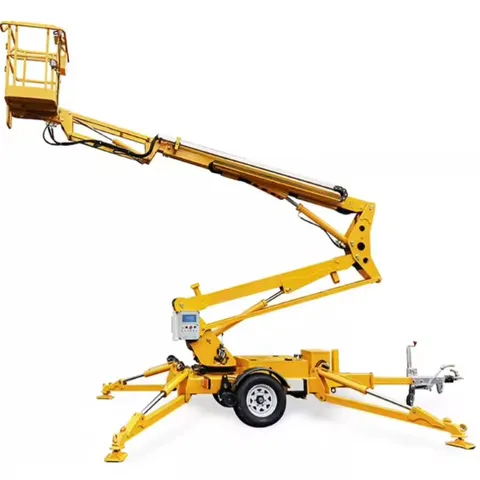
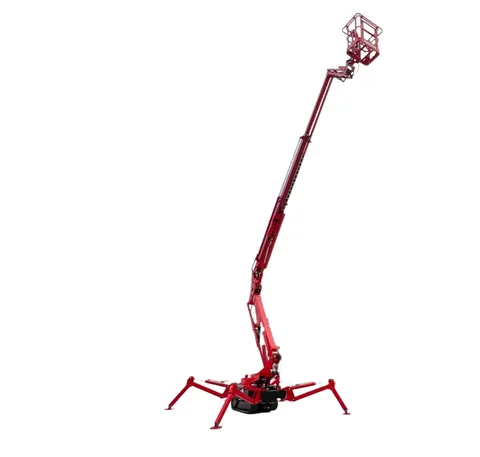
A boom lift carries a smaller basket at the end of an arm. Articulated booms have one or more joints, so the basket can climb over an obstacle and then reach down or across to the work point. Telescopic sections extend the arm in a straight line for longer reach. Trailer-mounted (towable) booms are pulled to site by a vehicle, and compact tracked booms spread their weight on wide outriggers so they can work in gardens, atriums and narrow courtyards.
Because the load is carried far from the base, boom lift baskets are usually designed for one or two people with hand tools — typically around 200–250 kg rated load. They are ideal for maintenance on building facades, signs, street lights and trees, or for reaching over production lines without stopping them.
Side-by-side comparison
- Movement: scissor lift — vertical only; boom lift — vertical plus horizontal outreach.
- Platform: scissor lift — large deck for several workers and materials; boom lift — compact basket for one or two workers.
- Load: scissor lift — commonly 300–1000 kg, up to 3000 kg on heavy-duty models; boom lift — usually around 200–250 kg.
- Space needed: scissor lift — compact footprint, works close to walls; boom lift — needs room for the boom and outriggers to swing.
- Ground: scissor lifts on wheels prefer firm, level floors; crawler versions handle rough ground; tracked booms level themselves on outriggers.
- Cost: for the same height, a scissor lift is normally the more economical choice to buy and maintain.
Five questions to decide
1. Is the floor directly under the work point reachable? If yes, a scissor lift is usually faster and cheaper. If not, you need outreach.
2. How many people and how much material go up? Ceiling installation, pipework and cable trays often need two or three people plus materials — a scissor deck is far more productive.
3. How high is the work? Check the data sheet carefully. By industry convention, working height is quoted as platform height plus about 2 m, the reach of a person standing on the deck. Make sure you compare like with like between suppliers.
4. What is the ground like? Indoor concrete suits self-propelled electric scissor lifts. Muddy, soft or uneven sites need crawler tracks, outriggers or a towable machine with stabilisers, and the ground bearing capacity must be checked.
5. How will the machine reach the site? Measure doors, ramps and lifts on the way in. Towable booms and trailer-mounted scissor lifts are designed for frequent moves between locations.
Typical applications
- Warehouses and logistics centres: scissor lifts for lighting, sprinklers and racking maintenance.
- Factories: scissor lifts for installation over clear floor; articulated booms to work over machines.
- Building maintenance: towable or tracked booms for facades, gutters and windows.
- Construction and fit-out: scissor lifts for ceilings, ducting and drywall; crawler scissor lifts on rough sites.
- Municipal and grounds work: towable booms for street lights, signage and tree care.
Still not sure?
Send us a photo of the work area, the height you need to reach, how many people will work on the platform and what the ground is like. Our engineers will recommend a scissor lift or boom lift model from our range and quote it with full specifications, delivery terms and documents.